:format(webp))
:format(webp))
Custom AI Agents for Sales: How to Qualify, Enrich, and Follow Up Without Breaking Trust
Read this and you’ll understand how custom AI agents can run the parts of your sales funnel that take the most time: scoring leads, filling missing data, and sequencing follow-ups — while avoiding common traps like hallucinations, regulatory risk, and bias. I’ll cover practical implementation choices, measurement ideas, and advanced signals (behavioral timing, competitive context, churn indicators) that most guides miss.
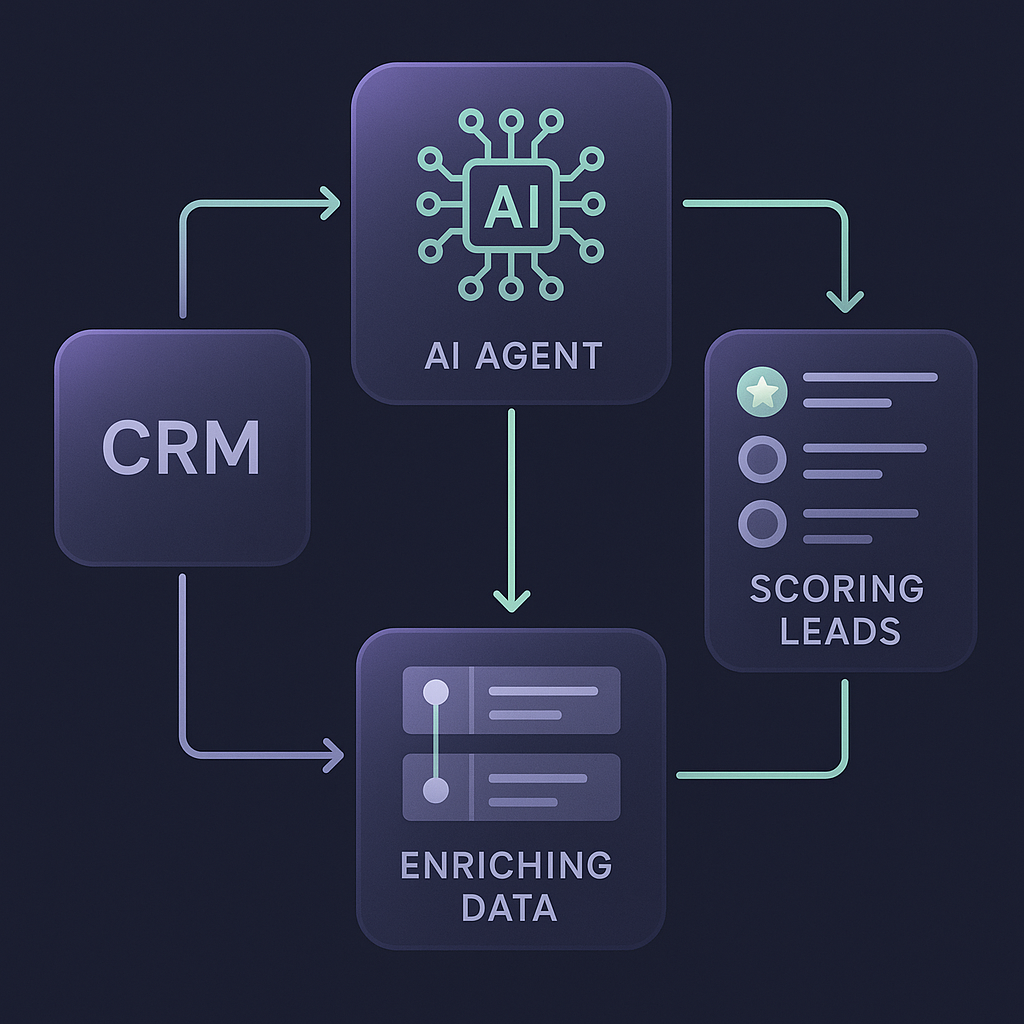
What "custom AI agents" mean for your sales operations
Custom AI agents are software systems that automate sales tasks by combining trained models, business rules, and integrations with your CRM and external data sources. They can score incoming leads, enrich records with firmographic and contact details, send personalized follow-ups across channels, and flag high-priority opportunities for reps. Vendors and platforms outline these capabilities as the core uses of AI in sales operations.
Lead qualification: scoring models, inputs, and what to watch for
AI lead scoring uses historical outcomes and behavioral signals to estimate a lead’s likelihood to convert. Typical features include firmographics, activity (email opens, site visits), engagement recency, and intent signals from content consumption.
Feature Category | Example Data Point | Description |
|---|---|---|
Firmographics | Company size | Organizational attributes like size or industry |
Activity | Email opens | Actions taken such as opening emails |
Engagement Recency | Days since last interaction | Time elapsed since the user's most recent activity |
Intent Signals | Topic engagement | Interest shown in specific topics via content usage |
What to do now:
Map which signals actually predict closed deals in your CRM before relying on a model.
Use explainable outputs (feature attributions) so reps see why a lead scored highly.
Watch out for bias:
If you train scores on historical closed deals, the model can inherit biases (for example, favoring certain industries or company sizes). Put fairness checks into your pipeline and periodically revalidate which features drive scores.
Lead enrichment: sources, accuracy risks, and hallucination
AI-driven enrichment pulls missing data (emails, phone numbers, titles) and can synthesize insights (company size, tech stack). Providers such as Clearbit offer enrichment APIs commonly used to populate CRM fields.
Hallucination and data accuracy risks:
Large language models and generative systems sometimes produce plausible but false statements (known as “hallucinations”). That risk matters when an AI agent fills contact fields or fabricates company details—bad data undermines outreach and credibility.)
Guardrails: prefer canonical enrichment APIs as primary sources; treat LLM-generated fields as suggestions requiring verification; implement confidence thresholds and automated validation against trusted sources (for example, verify an email via SMTP ping or ownership check).
Cross-border data and privacy constraints:
Not every enrichment source is legal to query for every prospect. The EU's GDPR and California’s CCPA set rules about personal data processing and rights that affect enrichment workflows.
Automated follow-ups: personalization, channels, and behavioral timing
AI makes follow-ups timely and personalized at scale: dynamic subject lines, tailoring based on prior interactions, and channel selection (email, SMS, chat).
Behavioral psychology and timing:
Response rates depend heavily on when and how you follow up. Studies show optimal send windows vary by audience and time zone; using recipient engagement patterns (open times, past response times) can improve opens and replies. Use models that learn each contact’s preferred times and channels, not just one-size-fits-all schedules.
Multi-language and cultural nuance:
Translation isn’t enough. Sales messaging should reflect local business etiquette, tone, and expectations. Approach: have localized templates curated by native speakers, allow cultural tone controls in your agent, and A/B test localized variants.
Predictive signals from follow-up interactions:
AI can detect when a prospect’s engagement signals a decline in interest (fewer opens, shorter replies, less interaction). Use predictive churn-detection techniques to alert reps or change cadence.
Real-time competitive intelligence: how it modifies prioritization and messaging
You can feed live competitive signals—pricing changes, product launches, public hiring, or active competitor campaigns—into lead prioritization. Competitive intelligence platforms describe how tracking competitor moves informs sales tactics; for a primer.
Practical use cases:
If a target company posts an RFP or hires aggressively in a product area, the agent can raise that account’s priority and push messaging that addresses the competitor gap.
Tie competitive intelligence signals to rules that adjust score weightings so sales reps get real-time context with each lead.
Implementation and architecture choices that matter
Data and model hygiene:
Centralize a canonical lead record in your CRM and make enrichment updates auditable. Document data sources and their freshness.
Keep a human-in-the-loop for uncertain predictions and enrichment outputs; require manual approval above a confidence threshold.
Explainability and rep trust:
Sales reps distrust black-box scores. Provide short rationales: “Scored high because: job title, recent product-pages visits, intent-topic mentions.”
Build interfaces that let reps override scores and record the reason—then feed that feedback into model retraining.
APIs, latency, and monitoring:
Enrichment calls and intent signals can add latency. Cache typical fields and run async enrichments so agents don’t block workflows.
Monitor model drift and data quality metrics (percent of leads with verified emails, rate of enrichment disagreement, score changes over time).
Compliance, privacy, and cross-border considerations
Legal constraints shape what you can store and how you use it. Key reference points:
GDPR requires lawful basis for personal data processing and gives EU subjects rights such as access and erasure.
CCPA grants California residents rights over their personal information and imposes disclosure obligations.
Operational steps:
Map which enrichment sources you use and document their legal basis per region.
Provide opt-out and data access flows that integrate with your CRM.
Keep records of processing activities and retention policies as required by regulators.
Measuring impact and ROI
Metrics to track:
Lead-to-opportunity conversion rate before vs. after AI scoring.
Time-to-first-contact and time-to-close reductions.
Enrichment accuracy rate (verified fields vs. filled-by-AI).
Rep adoption and override rate.
Metric | Definition |
|---|---|
Lead-to-opportunity conversion rate | Percentage of leads that convert into opportunities; compare rates before and after AI scoring. |
Time-to-first-contact | Average time elapsed from lead creation to first sales contact. |
Time-to-close | Average duration from lead creation to deal closure. |
Enrichment accuracy rate | Ratio of verified data fields to total fields filled by AI enrichment. |
Rep adoption and override rate | Percentage of reps using AI scores and frequency with which they manually override AI suggestions. |
Case-study evidence and industry reporting:
Vendors and analysts report AI can shorten sales cycles and increase rep productivity; use your baseline data to validate these claims within your business. For an example format, refer to HubSpot’s case study library.
Deployment checklist (short)
Audit CRM data and label high-quality outcomes for model training.
Select canonical enrichment sources and a verification layer.
Build explainability into score outputs and UI.
Add legal reviews for data flows (GDPR/CCPA).
Pilot with one team, measure lift, iterate.
Step | Description |
|---|---|
1 | Audit CRM data and label high-quality outcomes for model training. |
2 | Select canonical enrichment sources and a verification layer. |
3 | Build explainability into score outputs and UI. |
4 | Add legal reviews for data flows (GDPR/CCPA). |
5 | Pilot with one team, measure lift, iterate. |
Your next move: practical priorities to start with
If you only do three things this quarter:
Run a data quality audit and mark which enrichment fields you need most. (Start with emails, titles, and company size.)
Implement a human verification gate for any AI-generated enrichment before writing it to CRM.
Pilot behavioral follow-up sequencing on a segment and measure reply-rate improvement.
Final thought: custom AI agents can automate and personalize huge parts of your funnel, but they require deliberate data governance, explainability, and legal checks. Treat them as decision-support systems that raise rep effectiveness—not replacements for human judgment.
Want support for Custom AI Agents?
See our custom AI agent offering and reach out on demand.
Custom AI Agent Development:format(webp))
:format(webp))
:format(webp))