:format(webp))
:format(webp))
Composable Commerce Frontends: Leveraging ReactJS for Omnichannel Retail
In this article, you’ll discover how composable commerce transforms online retail, what makes a composable frontend unique, and why ReactJS has become the go-to library for building flexible, scalable storefronts. You’ll also learn about emerging trends—Progressive Web Apps, edge-powered rendering, IoT integration, component-level A/B testing, and security best practices—to stay ahead in omnichannel retail.
Understanding Composable Commerce
Composable commerce is an architectural approach that lets you assemble best-of-breed services (payment, search, inventory, personalization) through APIs and microservices rather than relying on a single, monolithic platform. For a deeper look at this definition, see BigCommerce’s guide on what is composable commerce .
Traditional vs. Headless vs. Composable
Traditional commerce ties frontend, backend, and data into one package.
Headless commerce decouples frontend from backend but often still relies on a single vendor; learn more in Shopify’s overview of headless commerce .
Composable commerce builds each piece independently, so you can swap or upgrade components without a full rewrite.
Architecture Type | Description |
|---|---|
Traditional commerce | Ties frontend, backend, and data into one package. |
Headless commerce | Decouples frontend from backend but often still relies on a single vendor. |
Composable commerce | Builds each piece independently, allowing components to be swapped or upgraded without a full rewrite. |
Benefits of composable commerce include:
Agility and rapid experimentation ( Gartner on composable commerce innovation )
Faster time to market
Lower total cost of ownership ( Accenture on composable commerce ROI )
Challenges you may face:
Integrating multiple APIs
Managing organizational silos when teams own different services
Recruiting engineers with specialized expertise
Defining a Composable Frontend
A composable frontend is a modular UI layer where independent “micro-frontends” collaborate via APIs. Unlike a traditional monolith, each component—product carousel, search bar, checkout widget—can be developed, tested, and deployed on its own schedule. Explore the micro-frontend pattern at MicroFrontends.org .
Key Characteristics
Decoupled architecture: Frontend components run independently, as described in the Micro Frontends architecture .
API-first: All data and business logic come through standardized endpoints—see MuleSoft’s take on an API-led approach .
Modular design: You can add, remove, or replace features without disrupting the whole UI—read ThoughtWorks’ insights on modular architecture .
Cloud-native: Often deployed as serverless functions or containers at scale; the Cloud Native Computing Foundation outlines key cloud-native traits .
Benefits include improved developer productivity and faster feature rollout. Common challenges are orchestrating cross-component communication and ensuring consistent branding across modules.
Why ReactJS Powers Composable Frontends
ReactJS dominates modern front-end development thanks to its component-based model and vast ecosystem.
Core Advantages
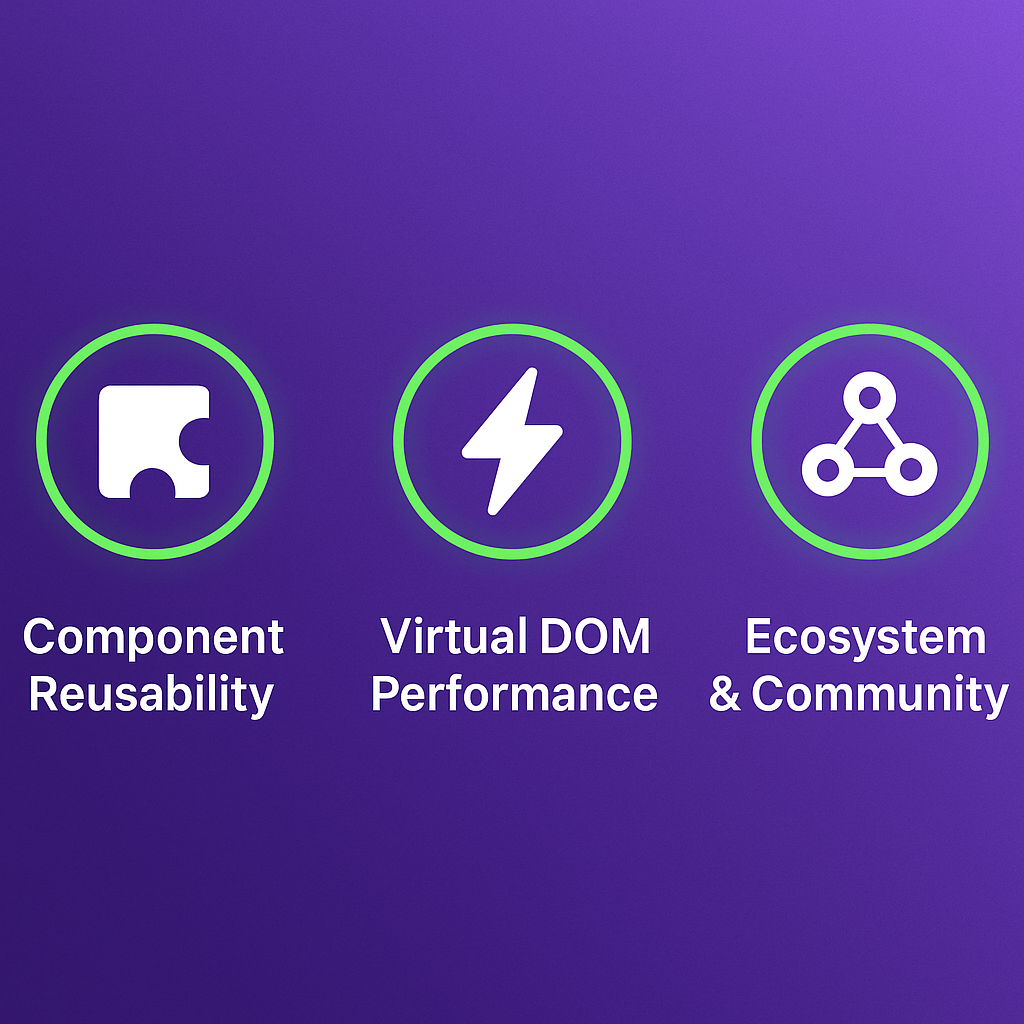
Component Reusability
Build isolated, reusable UI pieces that fit perfectly into a micro-frontend pattern—see the official React documentation on components .
Virtual DOM Performance
Efficient updates minimize reflows, crucial when stitching together multiple services—learn how this works in this LogRocket deep dive on the Virtual DOM .
Ecosystem & Community
With over 2 million weekly downloads, React offers mature libraries for routing, state management, testing, and more ( Stack Overflow Survey 2023 ).
ReactJS in E-commerce Use Cases
Product Galleries that lazy-load images for fast browsing, using techniques from MDN’s guide on lazy loading .
Personalized Recommendations fetching data from a headless CMS; see Contentful’s overview of a headless CMS approach .
Interactive Checkouts with real-time validations, as outlined in Stripe’s payment validation documentation .
Enabling Omnichannel Retail with ReactJS
Omnichannel retail means providing a unified experience—web, mobile, brick-and-mortar, kiosks, social commerce—where customers can start shopping on one channel and complete their journey on another.

Real-World Examples
A shopper browses items online, adds them to a wish list via a React PWA on mobile, then picks up in store using an in-aisle kiosk built with the same React components.
Wearable integrations send restock alerts to store associates, who use a React-powered handheld app to update inventory instantly.
Challenges include:
Data synchronization across channels—Deloitte explores strategies in their omnichannel data synchronization report .
Consistent UX despite different screen sizes and input methods.
React’s unidirectional data flow and Context API make it easier to share state (like cart contents) across mobile, web, and in-store apps; see FreeCodeCamp’s guide to React Context .
Emerging Trends in Composable Frontends
Below are advanced techniques that go beyond basic composable setups.
Trend | Key Benefit | Example/Tool |
|---|---|---|
Progressive Web Apps (PWAs) | Offline access & push notifications increase engagement by up to 50% | Service Workers & Web Push |
Edge SSR | Reduced latency & improved SEO | Next.js on Vercel Edge Network |
IoT Integration | Real-time inventory & personalized in-store offers | REST/WebSocket to smart shelves |
Component-Level A/B Testing | Isolated experiments without full redeploys | Optimizely |
Security Best Practices | Protect against API attacks & data leaks | OAuth2/JWT & CSP headers |
Progressive Web Apps (PWAs) for Offline & Push
React can power PWAs that deliver app-like speed, work offline with service workers, and send push notifications for order updates.
Offline access increases engagement by up to 50% ( Google Developers on PWA engagement ).
Push notifications drive repeat visits without needing an app store; see best practices on web.dev’s push notifications guide .
Edge Computing & Server-Side Rendering (SSR)
With frameworks like Next.js, you can render React components at the edge, reducing latency and improving SEO.
Edge SSR serves pre-rendered pages from locations near your user network ( Vercel Edge Network Overview ).
Real-time personalization—like pricing or promotions—can be applied per request before shipping to the browser.
IoT Device Integration
Composable frontends can connect to in-store smart shelves, kiosks, or wearables via REST or WebSocket APIs:
Smart Shelves trigger React dashboards when inventory runs low.
In-Hall Displays show personalized offers based on mobile app browsing history; learn more in IBM’s introduction to IoT .
Component-Level A/B Testing
Because each UI widget is isolated, you can experiment on individual components without full redeploys. Tools like Optimizely let you:
Swap out a recommendation widget.
Measure CTR differences.
Roll back or roll out without touching other modules ( Optimizely on component testing ).
Security in Composable Architectures
APIs and micro-frontends introduce new attack surfaces. Key best practices:
Implement OAuth 2.0 or JWT for inter-service authentication—see the OAuth 2.0 overview at oauth.net .
Follow OWASP API Security Top 10 guidelines to guard against injection, broken auth, and data leaks ( OWASP API Security ).
Use CORS and Content Security Policy headers to prevent cross-site attacks; refer to Cloudflare’s CSP documentation .
Next-Gen Retail Interfaces
By combining composable architecture, ReactJS, and these cutting-edge practices, you can create a resilient, agile storefront that delights shoppers on every channel. Whether you’re aiming for faster innovation cycles, seamless omnichannel journeys, or bullet-proof security, this approach positions your retail business for sustained growth in a competitive market.
:format(webp))
:format(webp))
:format(webp))