:format(webp))
:format(webp))
Jamstack: A Comprehensive Guide for Modern Web Development
By reading this, you’ll learn what Jamstack is, why teams choose it, how it works under the hood and in the cloud, plus new insights on sustainability, edge computing, accessibility, SEO trends in 2025, and migrating legacy platforms.
What Is Jamstack?
Jamstack is a web architecture built around client-side JavaScript , reusable APIs and prebuilt HTML markup . It separates (or “decouples”) the front end from the back end, delivering pages from a content delivery network rather than a monolithic server. This approach was popularized by Netlify’s JAMstack announcement in 2020.
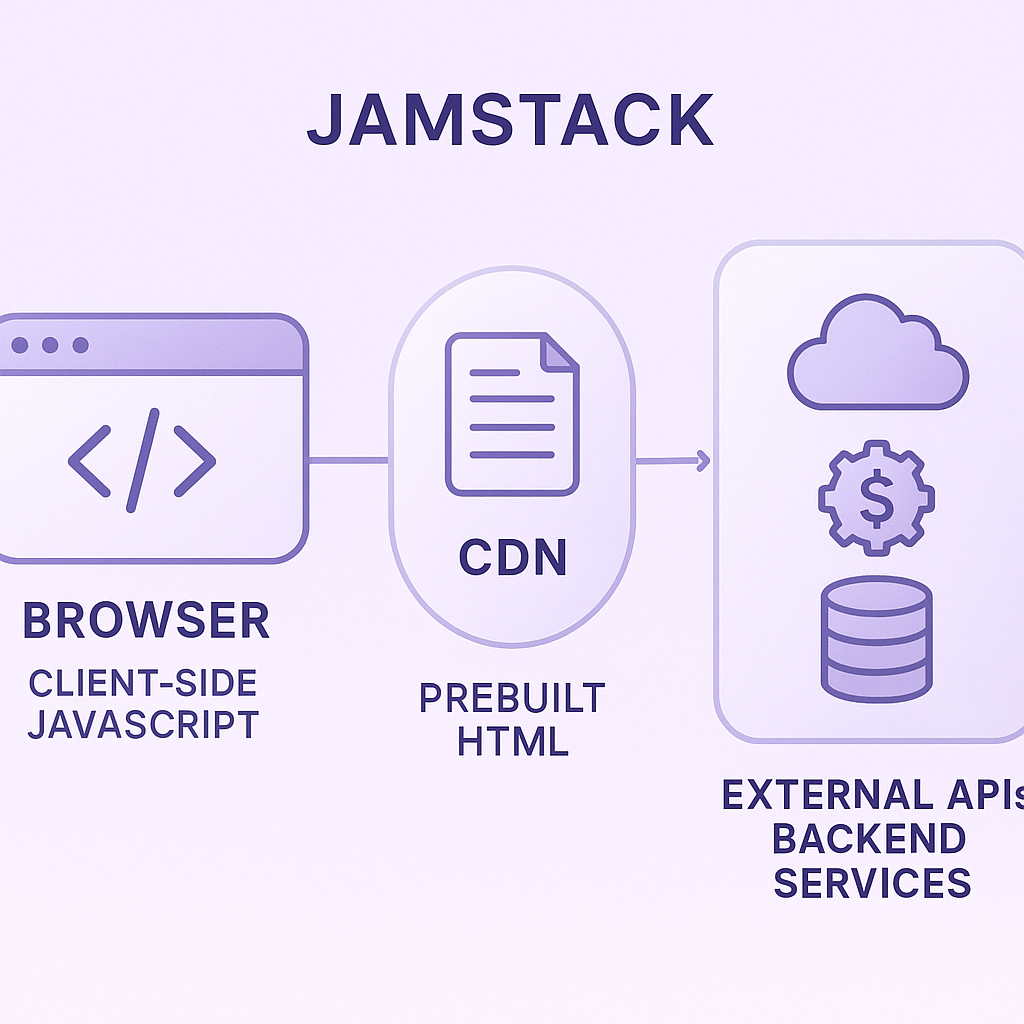
Core Principles
Pre-rendering
Pages are generated at build time into static files, so users get fast, cached responses.
Decoupling
The front end and back end communicate via APIs or microservices, which can be managed independently.
API-driven
Reusable services (authentication, payments, search) live elsewhere, reducing maintenance on your own servers.
Benefits of Jamstack
Teams often choose Jamstack for:
Faster page loads, with Core Web Vitals improvements of up to 50% .
Fewer vulnerabilities, as highlighted by the OWASP Top 10 report emphasizing reduced attack surfaces.
Lower hosting costs when leveraging CDNs for distribution, such as AWS CloudFront pricing .
Better developer workflow with local builds and instant previews, exemplified by Gatsby’s preview functionality .
Easy scaling during traffic spikes, leveraging modern CDNs like Fastly’s edge compute network .
Benefit | Impact/Metric |
|---|---|
Faster page loads | Up to 50% Core Web Vitals improvement |
Fewer vulnerabilities | Reduced attack surface per OWASP Top 10 |
Lower hosting costs | CDN-based pricing savings |
Better developer workflow | Local builds & instant previews |
Easy scaling | Seamless CDN edge compute |
An Eco-Friendly Architecture
Because static sites require less real-time server processing, they consume less energy. The Website Carbon Calculator shows that a typical dynamic page view emits about 1.76 g of CO₂, while a well-optimized static page can cut that by half, to roughly 0.88 g.
Page Type | CO₂ Emissions (g) |
|---|---|
Dynamic page view | 1.76 |
Optimized static page | 0.88 |
Tools and Technologies
Building a Jamstack site usually involves:
Static Site Generators (SSGs)
Examples: Gatsby, Next.js (static export), Hugo – learn more in this overview of static site generators .
Headless CMSs
Examples: Contentful, Sanity, Strapi – compare options at the Headless CMS directory .
CDNs
Services like Netlify, Vercel or Cloudflare Pages serve your prebuilt files globally.
Serverless / Edge Functions
Run custom code at the network edge with frameworks such as the Serverless Framework .
Common Use Cases
Marketing and brochure sites
E-commerce catalogs and storefronts
Documentation portals
Blogs and personal portfolios
The Role of Edge Computing
As Jamstack grows, edge computing ties in by running functions at CDN nodes. You can execute light personalization, A/B tests or geo-routing within milliseconds of the user:
Cloudflare Workers let you run JavaScript at the edge with global distribution and sub-millisecond response times .
Netlify Edge Functions integrate directly into your build and deploy flow.
Provider | Key Feature | Response Time | Integration |
|---|---|---|---|
Cloudflare Workers | Global distribution | Sub-millisecond | Standalone edge functions |
Netlify Edge Functions | Build/deploy integration | Millisecond-range | Built into Netlify pipeline |
This reduces latency and offloads work from origin servers.
Accessibility Considerations
Pre-rendered pages help screen readers by delivering semantic HTML instantly. But if you rely heavily on client-side hydration:
Invisible loading spinners or missing ARIA attributes can confuse assistive tech.
Always test the “no-JavaScript” experience to ensure content and navigation remain accessible.
Tip: Run Deque University accessibility testing and manual screen-reader tests before deploying.
SEO Advances in 2025
Search engines have improved their handling of JavaScript, but static HTML still offers a head start. According to Google Developers , bots now run a modern Chrome engine when crawling JS. That said:
Pre-rendered content ensures critical metadata is immediately available.
Use structured data (JSON-LD) in your HTML to help search engines identify products, articles or events.
Implement `rel="preload"` for key assets to speed up perceived load time.
Migrating Legacy Systems to Jamstack
Switching from a monolithic CMS or server-rendered site can introduce challenges:
Authentication workflows often need rethinking—for example, Auth0’s authentication platform .
Dynamic functionality (search, comments) must move to API-driven services.
Build times grow with large sites—consider incremental or on-demand builds (e.g., Next.js Incremental Static Regeneration ).
A step-by-step migration plan and small proof-of-concept project can minimize disruptions.
Your Jamstack Journey
You now have a holistic view of Jamstack’s architecture, tools and real-world considerations—from energy impact to edge functions, accessibility, SEO trends and migration pitfalls. Pick a small section of your existing site to rebuild, measure the gains and iterate. With each release you’ll refine performance, cut costs and create a modern experience your users (and the planet) will appreciate.
:format(webp))
:format(webp))
:format(webp))