:format(webp))
:format(webp))
Building a Next-Gen NFT Marketplace: Essential Features and Emerging Trends
By reading this guide, you’ll learn the must-have components powering today’s leading NFT platforms and discover cutting-edge features—from community tools to DeFi integrations—that can set your marketplace apart.
Core Features of an NFT Marketplace To compete, your platform needs a solid foundation. Nearly every top marketplace includes:
Storefront: A clean gallery showcasing collections and trending drops.
Search & Filters: Enable users to sort by price, rarity, creator, category or date.
Listing & Auction Tools: Support fixed-price sales, English auctions, Dutch auctions and bundled offers.
Wallet Integration: Connect MetaMask, WalletConnect, Coinbase Wallet and others for seamless transactions.
Ratings & Reviews: Help buyers assess creators and collections.
Activity Log: Show recent bids, sales and mints in real time.
Push Notifications: Alert users to bids, sales or new drops.
Feature | Description |
|---|---|
Storefront | Displays collections and trending NFT drops in an appealing, easy-to-navigate gallery. |
Search & Filters | Allows users to sort and find NFTs by price, rarity, creator, category, or date. |
Listing & Auction Tools | Enables fixed-price sales, various auction types, and bundled NFT offers. |
Wallet Integration | Connects users' wallets (e.g., MetaMask, WalletConnect) for secure and smooth transactions. |
Ratings & Reviews | Lets buyers evaluate creators and collections based on feedback and ratings. |
Activity Log | Shows real-time updates on recent bids, sales, and mints. |
Push Notifications | Notifies users instantly about new bids, sales, or NFT drops. |
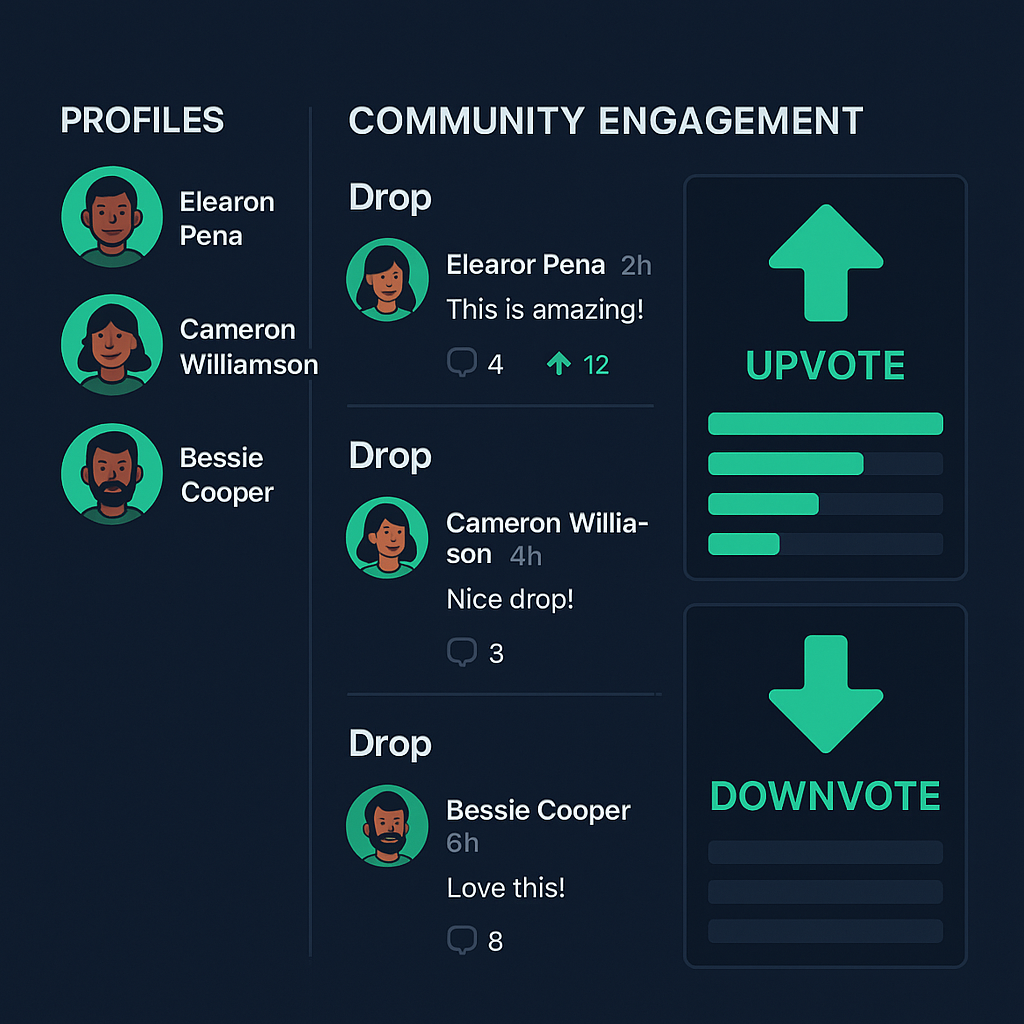
Community and Social Engagement Building a network effect around your platform boosts retention and discovery.
User profiles with bios, avatars and follow/following lists.
Community feeds where collectors and creators can comment on drops or share insights.
Curation boards or moderation tools driven by community votes.
“NFTs unlock a new type of digital community where creators and collectors interact directly.” – Chris Dixon, in a16z’s “What’s Next for NFTs” blog post
Fractional Ownership & Real-World Asset Tokenization Fractionalization lets users own shares of high-value assets, opening new markets.
Platforms like Unicly enable splitting an NFT into fungible tokens for shared ownership.
You can list tokenized real-world items—art, real estate, rare wines—so investors buy and trade fractions as ERC-20 tokens.
DeFi Mechanisms and Yield Opportunities Integrating decentralized finance features turns your marketplace into a full-service hub.
NFT Staking: Let collectors stake NFTs to earn platform tokens or fees, as with Rarible’s NFT staking feature .
Lending & Borrowing: Use NFTs as collateral for crypto loans.
Yield Farming: Reward liquidity providers who supply NFT pools or collateral vaults.
Feature | Functionality | Example Platform |
|---|---|---|
NFT Staking | Stake NFTs to earn platform tokens or a share of platform fees | Rarible |
Lending & Borrowing | Use NFTs as collateral to access cryptocurrency loans | NFTfi |
Yield Farming | Provide liquidity to NFT pools/collateral vaults and earn rewards | ApeSwap, SushiSwap |
Dynamic, AI-Powered NFTs Dynamic NFTs change based on external conditions or user interactions.
Platforms like Async Art’s programmable NFTs allow creators to build evolving layers that change over time.
AI-generated traits or visuals can unlock personalized collectibles responding to real-time data.
Custom vs. White-Label Solutions Choose between a quick-launch template or a fully bespoke platform:
White-Label: Prebuilt UI/UX, basic feature set, faster time to market (e.g., Mintbase ).
Bespoke: Tailor every aspect—branding, smart-contract logic, scalability—for long-term differentiation.
Cross-Chain and Multi-Blockchain Support Expanding beyond a single chain increases liquidity and user choice.
Support Ethereum, Polygon, Solana and Binance Smart Chain so collectors trade where fees and speed suit them.
OpenSea’s Polygon integration slashed gas costs, driving adoption by thousands of users.
Automated Royalties for Creator Revenue Keep artists earning with on-chain royalty enforcement.
Implement EIP-2981 royalty standard so creators receive a percentage of secondary sales automatically.
Eliminate manual payout headaches and improve trust among creators.
Gamification Strategies Incentivize repeat visits and higher engagement.
Issue platform tokens (e.g., LOOKS token on LooksRare ) as trading rewards.
Badges or achievement tiers for top bidders, collectors or community contributors.
Global Market Insights Understanding regional trends helps tailor offerings:
The NFT market hit roughly $41 billion in trading volume during 2021, according to CryptoSlam’s 2021 NFT volume report .
The U.S. accounted for approximately 37 percent of secondary market transactions, while Latin America and MENA emerged as some of the fastest-growing regions in the NonFungible Q3 2021 NFT Market Report .
Region | Metric |
|---|---|
Global | $41B trading volume in 2021 |
U.S. | 37% of secondary market transactions |
Latin America | Fastest-growing region |
MENA | Fastest-growing region |
The Road Ahead
By combining a rock-solid core with social features, DeFi hooks, cross-chain reach and gamification, you can build an NFT marketplace that stands out in a crowded field. Aim for seamless user experiences, transparent creator rewards and community-driven growth to stay ahead of the curve.
:format(webp))
:format(webp))
:format(webp))