:format(webp))
:format(webp))
Building a Scalable NFT Marketplace Frontend with React & Next.js
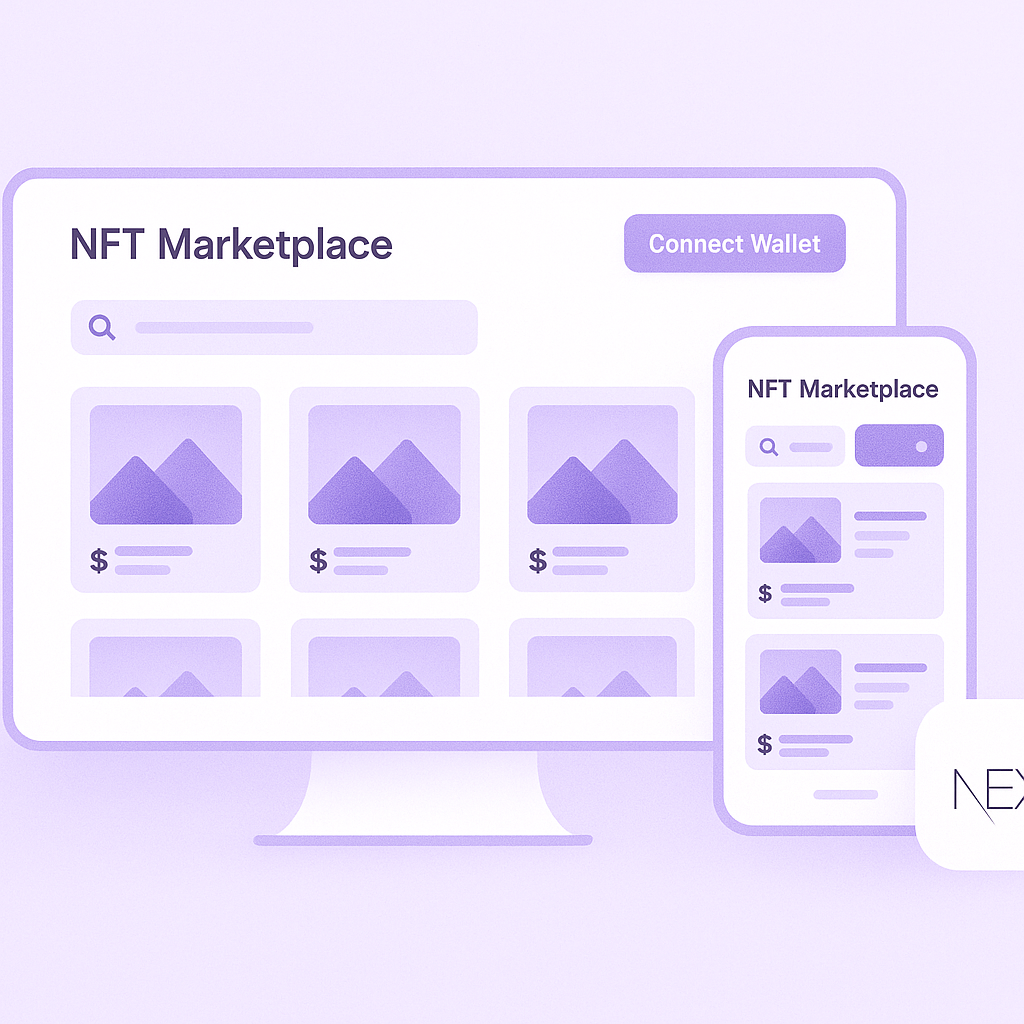
When you finish reading this, you’ll have a clear roadmap for creating a fast, feature-rich NFT marketplace frontend. You’ll learn how to set up your stack, connect wallets, render listings, optimize performance, add advanced UX like gasless transactions and real-time bid updates, and wrap it all up with SEO, accessibility, security, and testing best practices.
Setting Up Your Development Environment
Before writing a single line of code, install the tools you need:
Node.js (v16+): official Node.js (v16+)
Yarn for package management ( Yarn official site ) or npm
Git, for version control ( Git official site )
Tool | Purpose | Link |
|---|---|---|
Node.js | JavaScript runtime | |
Yarn / npm | Package management | |
Git | Version control |
Initializing a Next.js Project
npx create-next-app nft-marketplace-frontend
cd nft-marketplace-frontend
Refer to the Next.js create-next-app documentation for additional customization options.
Installing Core Dependencies
yarn add ethers wagmi @rainbow-me/rainbowkit moralis next-seo
Package | Description | Documentation Link |
|---|---|---|
ethers | A library for interacting with the Ethereum blockchain and its ecosystem. | |
wagmi | React hooks for Ethereum, enabling easy integration with wallets and contracts. | |
@rainbow-me/rainbowkit | A developer toolkit for integrating wallet connection UIs into React apps. | |
moralis | Provides APIs and SDKs for building decentralized apps with real-time data. | |
next-seo | A plugin for managing SEO in Next.js applications. |
Connecting to Web3 Providers and Authentication
You need a reliable RPC provider and wallet-connect UI.
RPC Setup
- Moralis: Moralis Web3 development platform
- Alchemy: Alchemy Developer Documentation
- QuickNode: quicknode.com
Wallet Connection
Use wagmi for React-friendly hooks and ethers.js for Ethereum interaction, including seamless MetaMask support.
Example Wagmi setup (in `_app.tsx`):
import { WagmiConfig, createClient } from 'wagmi';

import { connectorsForWallets, RainbowKitProvider } from '@rainbow-me/rainbowkit';


const client = createClient({ autoConnect: true, connectors: [...] });


function MyApp({ Component, pageProps }) {

  return (

    <WagmiConfig client={client}>

      <RainbowKitProvider>

        <Component {...pageProps} />

      </RainbowKitProvider>

    </WagmiConfig>

  );

}
Building Core Components
Your users expect a polished interface: header, NFT grid, listing modals, and transaction toasts.
Fetching NFT Data
Use The Graph with The Graph documentation for indexed subgraphs.
Moralis Queries: for quick database reads
Direct RPC calls via ethers.js
Handling Token Metadata
Normalize ERC-721 vs ERC-1155 schemas
Pin critical assets on IPFS/Arweave
Fallback to public gateways under load
Listing, Buying, and Selling NFTs
Implement seamless flows for minting, listing, bidding, and purchasing:
Contract Interaction
const contract = new ethers.Contract(address, abi, signer);

await contract.createListing(tokenId, price);
Gasless Transactions
Integrate OpenZeppelin’s Gas Station Network ( GSN documentation ) and show fee breakdown with fallback to user-paid gas.
Transaction UX
- Optimistic UI updates
- Toast notifications for pending/confirmed states
SEO & Social Previews for NFTs
Drive discovery with rich previews and dynamic sitemaps:
Next.js Metadata API for per-page `<title>` and Open Graph tags
Generate collection/user/token sitemaps on the fly
On-the-fly Open Graph images using Vercel Edge Functions
Statistic: Social posts with images receive 650% higher engagement ( Hootsuite's 2023 social media statistics report ).
Optimizing Media & Performance
NFTs often include high-res art or video. Keep your pages lean:
Next.js `<Image>` component for automatic WebP/AVIF conversion
Edge caching via CDN
Progressive video using `<video>` with AV1/WebM sources and HLS fallback
IPFS gateway fallback with exponential backoff
According to the HTTP Archive, the median page now has nearly 2 MB of images, so optimization is crucial ( HTTP Archive State of Images report ).
Rendering Strategies & Real-Time UX
Balance freshness and performance by choosing proper rendering modes:
SSG for static token pages
ISR (Incremental Static Regeneration) to refresh listings on-demand
SSR for user dashboards behind auth
CSR for pure client-only widgets
Rendering Strategy | Use Case | Update Frequency |
|---|---|---|
SSG | Static token pages | On build |
ISR | Listings refreshed on-demand | On-demand / Scheduled |
SSR | User dashboards behind authentication | On every request |
CSR | Pure client-only widgets | On user interaction |
Use on-chain events (WebSockets or `provider.on('block')`) to push real-time bid updates, countdown timers, and floor-price changes.
Advanced Features for Enhanced UX
As you scale, consider:
Multi-chain Support
Chain switcher UI
Unified price display with fiat conversion
Faceted Search & Filters
Trait ranges, verified collections, rarity-based sorting
Auction Variants
English, Dutch, sealed-bid flows with block-time sync
Accessibility
Keyboard navigation, ARIA labels for modals and transaction prompts
Mobile-First Wallet UX
WalletConnect deep links, QR code fallbacks, safe signing screens
Security, Compliance & Trust
Protect users from phishing and fraud:
Enforce EIP-712 typed data for human-readable signatures
Allowlist trusted contracts, sanitize user-supplied metadata
KYC/AML gating for high-value listings
Display royalties, marketplace fees, and creator splits up front
Quote: “Clear fee transparency builds trust and reduces disputes.” – OpenSea Team
Testing, Deployment & Observability
Ensure reliability with robust testing and monitoring:
Unit & Integration
Mock wallets with viem/wagmi
Cypress end-to-end flows for connect, sign, and buy
Deployment
Vercel or Netlify for global edge hosting
Analytics & Monitoring
Client-side event tracking for funnel drop-off
Core Web Vitals monitoring per page type
Error reporting for wallet or RPC failures
The Road Ahead
You’ve got a complete guide to building an NFT marketplace frontend that’s performant, secure, and packed with modern UX. As Web3 evolves, keep an eye on:
Decentralized indexers vs. centralized gateways
Enterprise admin dashboards and audit logs
Licensing indicators and moderation pipelines
Regional compliance and localization
With these patterns, you can craft a frontend that delights users today and adapts to tomorrow’s innovations.
:format(webp))
:format(webp))
:format(webp))